 :
:  :
:  :
:  :
: 
Our Blogs
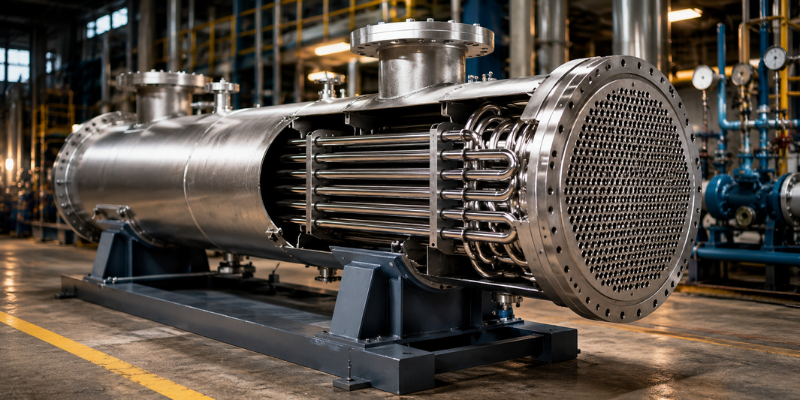
What Is A Heat Exchanger? Types, Working Principle, Industrial Applications & Benefits Explained
A heat exchanger is a device used to transfer heat from one fluid to another without mixing the fluids. It is used in many industrial applications, such as power plants, food processing, chemical production, refrigeration, oil refining, and HVAC systems. In today's world, various industries rely on advanced systems developed by Heat Exchanger manufacturers to enhance energy efficiency and ensure safe operating temperatures.
Working Principle of a Heat Exchanger
The operation of an industrial heat exchanger is straightforward. The equipment is filled with 2 fluids at different temperatures, which flow through 2 separate channels. Heat is transferred from the hot fluid to the cold fluid via a metal surface. This process is used for cooling, heating, condensation, or evaporation, depending on industry needs.
In industry, Oil Coolers, Evaporators, and Condensers are widely used machine equipment for controlling temperature and optimising machine performance. Efficient heat transfer also leads to lower energy use and operating expenses.
Types of Heat Exchangers
Shell and Tube Heat Exchanger
Shell Type Heat Exchanger Delhi is used in heavy industries due to its high-pressure and high-temperature characteristics. In this system, one fluid circulates within the tubes, and another circulates through the tubes in the shell.
Finned Tube Heat Exchanger
The Finned Tube Heat Exchanger is a heat exchanger with fins mounted on the tubes to improve heat transfer. Commonly used in air cooling systems and industrial ventilation systems.
Intercooler Heat Exchanger
The major use of an Intercooler Heat Exchanger is in compressors and/or engines. Cools compressed air before it reaches the next stage, increasing efficiency and preventing overheating.
Aftercooler Heat Exchanger
Aftercooler Heat Exchanger is used to extract heat from compressed air after compression. It helps to lower moisture and safeguards industrial equipment from damage.
Evaporator and Condenser
An Evaporator absorbs the heat to vaporise the liquid, while a Condenser removes heat to condense the vapour back to a liquid. Both systems are important to refrigeration and cooling applications.
Application of heat exchangers
This is applied in chemical and petroleum industries, marine systems, refrigeration, power stations, and chemical plants; it is called an Industrial Heat Exchanger. Generally, Oil Coolers are used to maintain oil temperature in hydraulic and lubrication systems. Likewise, a Shell Type Heat Exchanger in Delhi is favoured in industrial processing because of its durability and efficiency.
Advantages of Heat Exchangers
There are various benefits to employing a heat exchanger, such as energy savings, operational efficiency gains, lower maintenance costs, and greater temperature control. Other systems, such as Finned Tube Heat Exchangers, Intercooler Heat Exchangers, and Aftercooler Heat Exchangers, also help ensure equipment performance and boost production reliability across industries.
Overall, heat exchangers are essential components of various industrial processes and applications, helping regulate temperature and maintain system stability. Advance International offers trusted industrial solutions engineered to meet diverse heat transfer needs.
(FAQs)
What is a heat exchanger used for?
A heat exchanger is used to transfer heat between two fluids without mixing them. It is commonly used for cooling, heating, condensation, and evaporation in industrial systems.
How does a heat exchanger work in industrial systems?
A heat exchanger works by allowing hot and cold fluids to pass through separate channels. Heat transfers through a metal surface, helping control temperature efficiently.
What are the main types of heat exchangers?
The main types include shell-and-tube heat exchangers, plate heat exchangers, finned-tube heat exchangers, intercoolers, aftercoolers, evaporators, and condensers.