 :
:  :
:  :
:  :
: 
Our Blogs
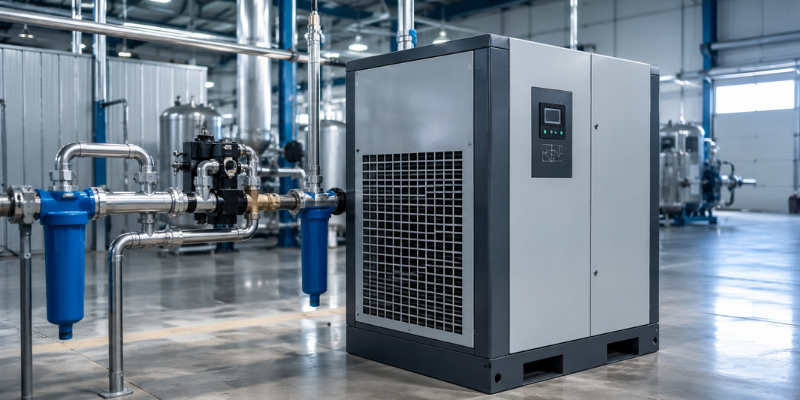
What Is A Refrigerated Compressed Air Dryer? Working, Benefits, Maintenance & Industrial Uses
Refrigerated Compressed Air Dryers are crucial components in many compressed air systems employed in various industries. Dries compressed air before it gets to machines and tools. Water in air pipelines can cause rust, damage equipment, contaminate systems, and reduce efficiency. Hence, industries opt for a Compressed Air Dryer to keep the compressed air clean and dry.
Such systems are often preferred for their reliability, energy efficiency, and suitability for continuous industrial applications.
Working principle of a refrigerated compressed air dryer?
A Refrigerated Compressed Air Dryer is designed to condense the water vapour in the compressed air into liquid form by cooling it to a low temperature. The moisture is then removed and drained from the system. The dry air is then reheated slightly after this process and passed through the pipeline.
The typical dew point for most systems is about 3°C, which is sufficient for many industrial applications. In a normal factory setting, where exceptionally dry air is not necessary, Refrigerated Air Dryers are more applicable than either a Heatless Air Dryer or Desiccant Air Dryer.
Advantages of the Industrial Air Dryer
There are several advantages to using an Industrial Refrigerated Air Dryer. It prevents moisture-induced machinery breakdowns and protects machinery from corrosion. Other industries, such as food processing, pharmaceuticals, textiles, and automotive, benefit from using dry compressed air to enhance product quality.
A Low-Pressure Refrigerated Air Dryer is particularly effective when a lower operating pressure is required while maintaining constant airflow. These systems have the added advantage of lower maintenance costs, as pipelines are less prone to wear and tear due to moisture-free conditions.
Another advantage is that of energy efficiency. In general, refrigerated systems use less energy than some advanced drying technologies, making them more economical in the long run at an industrial scale.
Tips to Maintain the Performance of Compressed Air Dryer
Proper maintenance of a Compressed Air Dryer can extend its performance for several years. Filters should be cleaned regularly, as dirt may build up over time. Condensate drains must also be routinely inspected, as blocked drains can result in water accumulation.
Operators must check the refrigerant levels, the pressure readings and that there is sufficient airflow around the unit. Regular maintenance helps keep things running smoothly and minimises potential downtime.
For ultra-dry air applications, a Desiccant Air Dryer is employed, but refrigerated systems are relatively easier to maintain and operate in routine industrial operations.
Industrial Applications of Industrial Air Dryer
Industrial Air Dryer is commonly found in industrial plants, packaging industries, hospitals, chemical plants, automotive workshops, etc. It is used to maintain clean air in pneumatic tools, compressors, and production machinery.
Industries for stable production select a Refrigerated Compressed Air Dryer to extend the life of expensive equipment. These systems are vital to ensure the efficient operation of the factory in many cases. Advance International offers industry expertise and technical assistance for advanced compressed air solutions and an understanding of industrial drying systems.
(FAQs)
How does a refrigerated compressed air dryer work?
It cools compressed air to condense moisture into water. The water is removed through a drain system, and the dry air is then supplied to industrial equipment.
Why is moisture removal important in compressed air systems?
Moisture can damage machinery, cause corrosion, contaminate products, and reduce system efficiency. Dry air improves performance and equipment life.
What industries use refrigerated compressed air dryers?
Industries such as automotive, pharmaceuticals, food processing, textiles, chemicals, and manufacturing commonly use these systems to supply clean, dry compressed air.