 :
:  :
:  :
:  :
: 
Our Blogs
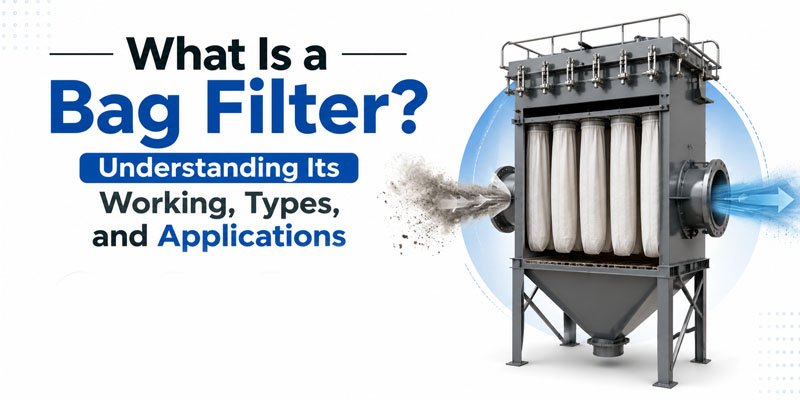
What Is a Bag Filter? Understanding Its Working, Types, and Applications
One of the most widely used filtration processes is the Bag Filter. It is intended for the separation of dust, particles and contaminants from air, gas or liquid flows. The Bag Filter is widely utilised in manufacturing factories, chemical industries, food processing units, pharmaceuticals and cement factories because it is easy to make and has a high filtration efficiency. Filter Bag Manufacturers are relied upon by many industries to ensure consistent filtration operations and safety.
How Does a Bag Filter Work?
The principle of a Bag Filter is very simple. Polluted air or water is drawn into the filter chamber and passes through the filter bag, which is specially designed. The filter media is used to trap dust, dirt, and other undesirable particles while allowing clean air or liquid to pass through.
The dust layer formed on the surface of the filter bag enhances the filtering efficiency. When the filter bag becomes loaded with contaminants, it is cleaned or replaced to maintain appropriate flow and performance. A trustworthy Bag Filter Manufacturer offers filtration solutions appropriate for various operating conditions and particle sizes.
Categories of Bag Filters
Pulse Jet Bag Filter
It is the most widely used type of Bag Filter in an industrial dust collection system. Compressed air automatically pulses the filter bags, cleaning them with minimal downtime.
Shaker Bag Filter
Mechanical shaking will be used to remove dust accumulation in the filter bags in this system. It is appropriate for applications with moderate dust loads.
Reverse airflow
Reverse airflow is used to clean the filter bags. These systems are often found in large industrial plants where continuous filtration is required.
Liquid Bag Filter
The Liquid Bag Filter is a device that removes solid particles from liquids. In water treatment, chemical processing and food manufacturing.
Applications of Bag Filters
A Bag Filter is a very important component for product quality and environmental compliance. Common applications include:
• Cement manufacturing plants
• Pharmaceutical production units
• The processing of food and beverages.
• Chemical and petrochemical industry
• Power generation facilities
• The water and wastewater treatment systems.
• Metal processing industries
Many industrial plants collaborate with professional Filter Bag Manufacturers to select the appropriate filter media for their specific operating environment.
Advantages of Bag Filters
The main benefits of a Bag Filter are its high efficiency, low maintenance, cost-effective operation, and versatility across various industrial processes. A reputable Bag Filter Manufacturer can supply modern filtration systems that provide high efficiency and high airflow, trapping very fine particles.
Conclusion
Knowing the operating type and applications of a Bag Filter helps industries select the appropriate filter to meet their operational needs. The use of good-quality filter bags helps achieve cleaner processes, greater efficiency, and compliance with environmental standards. Advance International offers filtration solutions and industry expertise to meet the efficient industrial filtration needs across different sectors.
(FAQs)
What is a bag filter used for?
A Bag Filter is used to remove dust, dirt, and unwanted particles from air, gas, or liquid streams. It helps maintain product quality, protects equipment, improves workplace safety, and supports environmental compliance in industries such as manufacturing, pharmaceuticals, chemicals, and food processing.
What are the different types of bag filters?
The main types of Bag Filter systems include pulse-jet bag filters, shaker bag filters, reverse-air bag filters, and liquid bag filters. Each type is designed for specific applications, operating conditions, filtration requirements, and cleaning methods to ensure efficient and reliable performance.
Which industries commonly use bag filters?
A Bag Filter is commonly used in cement plants, pharmaceutical companies, chemical industries, food processing units, power plants, metal manufacturing facilities, and wastewater treatment systems water filtration. These industries depend on effective filtration to control contamination, improve efficiency, and meet regulatory standards.