 :
:  :
:  :
:  :
: 
Our Blogs
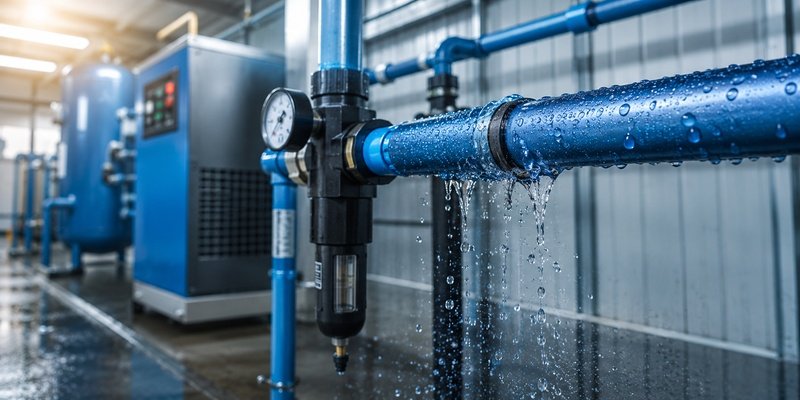
Why Is Water Coming in Compressed Air Lines? Causes & Solutions
Water coming through compressed air lines is a common problem in industrial pneumatic systems. It can lead to rusted pipelines, damaged pneumatic tools, clogged filters, poor product quality, and unexpected maintenance costs. The problem usually occurs because atmospheric air naturally contains water vapour. During compression, this moisture becomes concentrated, and as the compressed air cools, the vapour can turn into liquid water.
For businesses using compressed air continuously, simply installing a compressor is not enough. An effective moisture management system may require an aftercooler, moisture separator, air dryer, filters, and properly maintained condensate drains. Understanding why water enters compressed air pipelines is the first step toward preventing it.
Why Is There Water in Compressed Air Lines?
The primary reason is condensation. Atmospheric air entering the compressor contains moisture. Compression increases the air temperature and concentrates the moisture. When this hot compressed air subsequently cools inside the receiver, dryer, or pipeline, water vapour reaches its pressure dew point and condenses into liquid.
The problem can become worse when:
• Ambient humidity is high.
• Compressor discharge air is not adequately cooled.
• Aftercoolers are dirty or undersized.
• Moisture separators are missing or incorrectly sized.
• Automatic drains are blocked or malfunctioning.
• The air dryer cannot handle the actual flow or inlet temperature.
• Distribution pipes pass through colder areas.
• The compressed air system has poor piping design.
Common Causes of Water Coming in Compressed Air Lines
1. High Humidity in Intake Air
Compressors continuously draw atmospheric air. During humid weather, the incoming air contains more water vapour. After compression and cooling, a larger quantity of moisture can condense.
This is particularly noticeable in industrial facilities operating in hot and humid environments.
2. Inadequate Aftercooling
Compressed air leaves the compressor at a high temperature. An aftercooler reduces this temperature and helps convert water vapour into liquid so that it can be separated and drained.
If the aftercooler is dirty, damaged, undersized, or operating with excessive inlet temperature, moisture may remain in the compressed air system. Aftercoolers should also be maintained regularly to preserve heat-transfer performance.
3. Faulty Moisture Separator
A moisture separator removes liquid water droplets from compressed air after cooling. If it is missing, incorrectly sized, or not maintained, condensed water can travel further into the pipeline.
A separator is particularly important because liquid moisture should be removed before it reaches sensitive downstream equipment.
4. Blocked or Failed Condensate Drains
Even when an aftercooler, separator, and dryer are installed, water can still enter the pipeline if condensate drains are not functioning properly.
Blocked drains allow collected water to remain inside the system until air pressure carries it downstream. Failed automatic drains are a recognised cause of moisture being pushed into compressed air systems.
5. Incorrect Air Dryer Selection
An air dryer must be selected according to the required pressure dew point, flow rate, inlet temperature, ambient conditions, and application.
A refrigerated dryer is commonly suitable for general industrial applications, while desiccant dryers are preferred where much lower dew points are required, including certain cold-environment and sensitive manufacturing applications.
6. Condensation Inside Distribution Pipes
Installing a dryer does not automatically eliminate every moisture problem. If compressed air cools significantly after leaving the dryer, residual water vapour can condense inside downstream piping.
This is particularly relevant when pipelines run through outdoor, unheated, or cold areas.
How to Remove Water From Compressed Air Lines
A reliable moisture-control system should address water at multiple stages rather than depending on a single component.
Step 1: Install an Aftercooler
An aftercooler reduces compressed-air temperature and encourages moisture to condense where it can be separated and drained.
Step 2: Use a Moisture Separator
A properly sized separator removes condensed liquid from the air stream after cooling. This reduces the moisture load entering the dryer.
Step 3: Install the Right Air Dryer
For most general industrial applications, a refrigerated dryer can provide suitable drying performance. Where the process requires a much lower pressure dew point, a desiccant dryer may be more appropriate.
Step 4: Maintain Condensate Drains
Check drains at the aftercooler, receiver, filters, separators, and dryer. Automatic or zero-air-loss drains can help remove condensate without unnecessarily wasting compressed air.
Step 5: Inspect Filters and Piping
Filters should be cleaned or replaced according to operating conditions. Inspect pipelines for low points where condensate can collect, and make sure drainage arrangements are provided where necessary.
Refrigerated Dryer vs Desiccant Dryer
| Feature | Refrigerated Dryer | Desiccant Dryer |
|---|---|---|
| Typical use | General industrial applications | Critical or very dry-air applications |
| Pressure dew point | Around +3°C is common | Can reach much lower levels |
| Operating cost | Generally lower | Generally higher |
| Cold environments | May have limitations | Better suited when very low PDP is required |
| Suitable for | Manufacturing, workshops, general pneumatic systems | Laboratories, sensitive processes, cold environments |
The correct choice depends on the required pressure dew point rather than simply choosing the dryer with the lowest possible moisture level. Drying air more than necessary can increase operating costs, while insufficient drying can cause condensation and equipment problems.
How to Prevent Water in Pneumatic Lines
Prevention is easier and more economical than dealing with moisture-related equipment damage. Industrial facilities should consider the following practices:
• Keep compressor aftercoolers clean.
• Install a properly sized moisture separator.
• Select an air dryer based on actual operating conditions.
• Check dryer performance and pressure dew point regularly.
• Inspect automatic drains for blockage or failure.
• Drain condensate from receivers and filters.
• Avoid unnecessary low points in compressed air piping.
• Protect outdoor or cold distribution lines from condensation.
• Replace clogged or saturated filter elements.
• Monitor pressure, temperature, airflow, and dryer performance.
A complete compressed air treatment arrangement may therefore include an aftercooler → moisture separator → filter → air dryer → final filter → distribution network. The exact configuration should be selected according to air quality requirements and operating conditions.
Why Moisture Control Matters in Industrial Systems
Water in compressed air is more than a minor maintenance inconvenience. It can cause corrosion inside pipelines and receivers, interfere with pneumatic equipment, contaminate manufacturing processes, and increase downtime. Moisture can also damage components such as valves, cylinders, air tools, and control systems.
Proper air treatment helps maintain consistent compressed-air quality and can reduce avoidable maintenance problems. Industrial compressed-air systems therefore benefit from treating moisture as part of the overall system design rather than attempting to remove water only at the point of use.
Why Choose Advance International for Compressed Air Treatment?
Advance International provides industrial air-treatment solutions designed to address moisture and air-quality requirements across compressed-air systems. Selecting the right moisture separator, air dryer, filtration equipment, and condensate-management solution depends on factors such as compressor capacity, operating pressure, flow rate, temperature, and required dew point.
If your facility is experiencing water in pneumatic lines, frequent filter clogging, or moisture-related equipment problems, reviewing the complete air-treatment arrangement can help identify the underlying cause.
Conclusion
Water coming into compressed air lines is usually caused by moisture present in atmospheric air that condenses as compressed air cools. High humidity, inadequate aftercooling, faulty drains, poor moisture separation, incorrect dryer selection, and cold distribution piping can all contribute to the problem.
The most effective solution is a properly designed moisture-management system using the right combination of aftercoolers, moisture separators, filters, air dryers, and condensate drains. For general industrial requirements, refrigerated dryers are commonly suitable, while applications requiring lower pressure dew points may need desiccant drying.
For dependable compressed-air quality, consult Advance International to assess your application and select suitable air-treatment equipment for your system.
FAQs
1. Why does water accumulate inside compressed air pipelines?
Water accumulates because atmospheric air contains moisture. Compression concentrates this moisture, and when compressed air cools, water vapour can condense into liquid inside receivers, dryers, and pipelines.
2. How can moisture be removed from compressed air lines in industrial systems?
Moisture can be controlled using an aftercooler, moisture separator, suitable air dryer, filters, and properly functioning condensate drains. The equipment should be correctly sized and maintained for the operating conditions.
3. Which air dryer or moisture separator is best for preventing water in pneumatic lines?
For many general industrial applications, a refrigerated dryer is suitable. Desiccant dryers are generally considered when a much lower pressure dew point is required. A moisture separator should also be installed to remove liquid water before it reaches downstream equipment.