 :
:  :
:  :
:  :
: 
Our Blogs
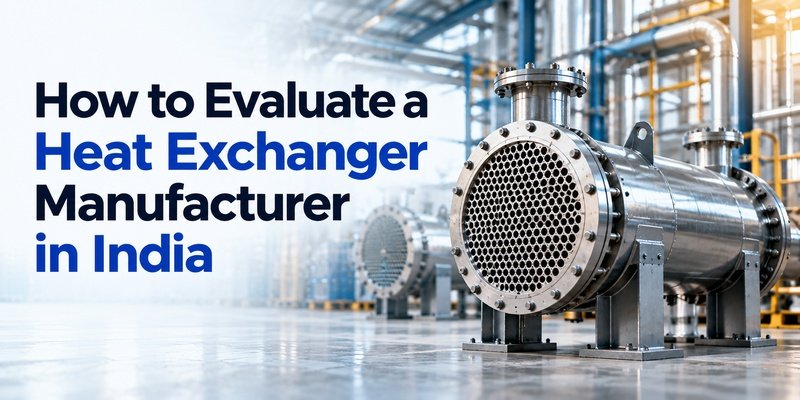
How to Evaluate a Heat Exchanger Manufacturer in India
Choosing the right heat exchanger manufacturer in India is an important decision for industries that depend on efficient heat transfer, process stability, and reliable equipment performance. A heat exchanger may look like a straightforward industrial component, but its design, materials, fabrication quality, thermal efficiency, and after-sales support can directly affect operating costs and plant productivity. With several manufacturers and suppliers available, comparing them only on price can lead to problems later. Instead, buyers should assess technical expertise, manufacturing capabilities, quality standards, customisation options, delivery commitments, and service support. This guide explains the key factors to consider when evaluating a heat exchanger manufacturer, helping industrial buyers make a practical and informed choice.
What Makes a Reliable Heat Exchanger Manufacturer?
A reliable manufacturer should offer more than standard equipment. The company should understand the application's operating conditions and recommend a suitable design.
Consider these factors:
• Manufacturing experience: Look for experience with industrial heat-transfer applications.
• Technical expertise: The manufacturer should have qualified engineers who can understand process requirements.
• Product range: A wider range can indicate the ability to handle different applications.
• Customisation: Equipment should be designed according to temperature, pressure, flow rate, fluid properties, and available space.
• Quality control: Manufacturing should involve proper inspection and testing at different stages.
• After-sales support: Installation guidance, maintenance assistance, and technical support can be valuable throughout the equipment's service life.
How to Evaluate a Heat Exchanger Manufacturer in India
1. Check Technical and Design Capabilities
Start by examining whether the manufacturer can design equipment according to your specific process requirements. Important parameters include inlet and outlet temperatures, operating pressure, flow rates, heat-transfer duty, fluid characteristics, and material compatibility.
A capable heat exchanger manufacturer in India should be able to discuss these requirements clearly rather than simply offering a catalogue product.
2. Examine Manufacturing Quality
The quality of fabrication has a direct impact on equipment reliability. Check the manufacturer's production facilities, fabrication practices, welding capabilities, inspection procedures, and testing methods.
Ask whether the company conducts appropriate checks for dimensions, weld quality, pressure integrity, material specifications, and overall construction before dispatch.
3. Assess Material Selection
Heat exchangers may operate with corrosive chemicals, high temperatures, steam, water, oils, gases, or other process fluids. Therefore, material selection should match the application.
Depending on operating conditions, manufacturers may work with materials such as carbon steel, stainless steel, or specialised alloys. A knowledgeable manufacturer should explain why a particular material is suitable instead of selecting it solely on cost.
4. Compare Product Types and Applications
Industrial requirements vary considerably. Common heat exchanger designs include:
| Heat Exchanger Type | Common Application |
|---|---|
| Shell and tube | Process heating, cooling, oil and chemical industries |
| Plate heat exchanger | Compact heating and cooling applications |
| Air-cooled heat exchanger | Cooling where water availability is limited |
| Double-pipe heat exchanger | Smaller heat-transfer duties |
| Condenser | Converting vapour into liquid |
The right choice depends on heat duty, pressure, temperature, fluid properties, maintenance requirements, and available installation space.
5. Review Testing and Quality Documentation
Before finalising a heat exchanger supplier in India, ask about quality documentation and inspection records. Depending on the project, relevant documents may include material certificates, test reports, inspection reports, drawings, and other manufacturing records.
Clear documentation helps buyers verify that the supplied equipment meets the agreed specifications.
Compare Cost with Total Value
Price should not be the only deciding factor. A cheaper heat exchanger may become expensive if it requires frequent maintenance, consumes more energy, or has a shorter service life.
When comparing a heat exchanger supplier, consider:
• Initial equipment cost
• Expected operating efficiency
• Maintenance requirements
• Spare-part availability
• Installation expenses
• Expected service life
• Technical support
A proper comparison should focus on the total value delivered over the equipment's working life.
Why Choose Advance International?
Advance International focuses on industrial equipment solutions with attention to engineering requirements, product quality, and application-specific needs. When evaluating a heat exchanger supplier, buyers need a company that can understand technical specifications and provide suitable solutions rather than treating every requirement the same.
For businesses looking for dependable heat-transfer equipment, Advance International can be considered for discussions around product selection, specifications, and industrial requirements.
Conclusion
Selecting a heat exchanger manufacturer in India requires careful evaluation of engineering capabilities, manufacturing quality, material selection, testing, customisation, pricing, and after-sales support. The right heat exchanger manufacturer should be able to match equipment design with the actual operating conditions of your plant. Instead of comparing quotations on price alone, assess long-term reliability, efficiency, documentation, and service support. Advance International can help industrial buyers explore suitable heat exchanger solutions based on their specific application requirements.
Looking for a suitable heat exchanger supplier in India? Contact Advance International to discuss your industrial heat-transfer requirements and identify an appropriate solution.
FAQs
1. What factors should you consider when choosing a heat exchanger manufacturer in India?
Consider manufacturing experience, engineering capabilities, product quality, material selection, testing procedures, customisation, delivery timelines, documentation, pricing, and after-sales support. The manufacturer should also understand your process conditions and recommend equipment suitable for your application.
2. How do you evaluate the quality of a heat exchanger manufacturer?
Evaluate its manufacturing facilities, fabrication practices, quality-control procedures, testing capabilities, technical documentation, and previous industrial experience. You can also ask about material certificates, inspection reports, pressure testing, and other quality checks performed before equipment delivery.
3. What types of heat exchangers are commonly used in industrial applications?
Common types include shell-and-tube, plate, air-cooled, double-pipe heat exchangers, and condensers. Selection depends on factors such as heat-transfer duty, pressure, temperature, fluid characteristics, maintenance requirements, and available installation space.