 :
 :
 :
 :

Our Blogs
Commercial Filter Manufacturers in Delhi: GRAP Smog Season Guide
Delhi’s air quality often deteriorates during winter, making indoor air filtration an important concern for offices, factories, hospitals, shopping centres, and other commercial buildings. During the Graded Response Action Plan (GRAP) season, rising particulate pollution can affect indoor comfort even when doors and windows remain closed. Choosing suitable filtration for heating, ventilation, and air conditioning (HVAC) systems helps reduce airborne particles and supports a healthier indoor environment. Businesses searching for reliable Commercial Filter Manufacturers in Delhi should understand filter efficiency, system compatibility, maintenance requirements, and airflow before making a purchase. Advance International helps businesses explore filtration solutions suited to their operational requirements. This guide explains how commercial filters work, what to consider during Delhi’s smog season, and how regular maintenance can help commercial buildings manage indoor air quality more effectively.
1. Understanding Delhi’s GRAP Smog Season
GRAP is a framework used to implement progressively stricter pollution-control measures when air quality deteriorates in Delhi and the National Capital Region. During severe pollution episodes, outdoor particulate matter can enter buildings through ventilation systems, doors, windows, and other openings.
Commercial premises face different filtration challenges depending on their location, occupancy, activities, and HVAC design. Offices need comfortable working environments, while manufacturing facilities may require specialised filtration to protect processes and equipment.
Businesses should consider these measures:
• Monitor local air quality advisories and applicable GRAP restrictions.
• Inspect HVAC filters and ventilation equipment before winter.
• Seal unintended air leaks without compromising required ventilation.
• Arrange professional assessments where indoor air quality is a concern.
2. How to Choose the Right Commercial Filter
Not every filter provides the same level of protection. The right Commercial Filter depends on the particle sizes that need to be captured, the system’s airflow capacity, and the manufacturer’s efficiency specifications.
Common options include:
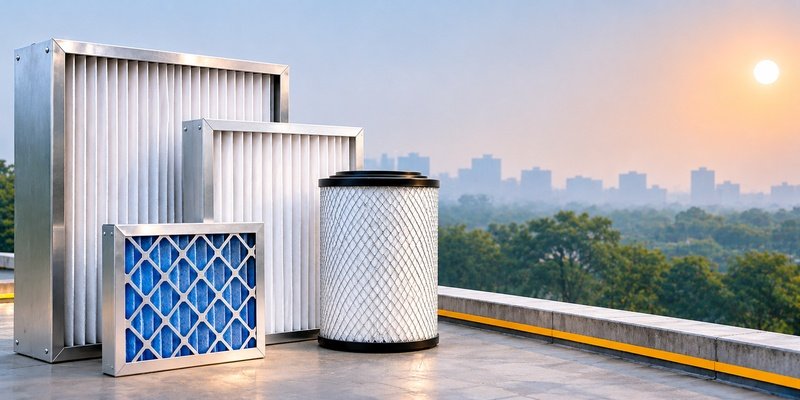
• Panel and pleated filters: Often used as pre-filters to capture larger airborne particles and protect downstream filtration stages.
• Fine-particle filters: Designed to capture smaller particles, depending on their rated efficiency.
• HEPA filters: High-efficiency particulate air filters can capture at least 99.97% of particles measuring 0.3 micrometres under the relevant US test standard. They require suitable installation and adequate system capacity.
• Specialised filters: Certain commercial environments may need filtration designed for specific dust, fumes, or other contaminants.
The best selection balances filtration efficiency with pressure drop, airflow, installation requirements, and maintenance costs.
3. What to Look for in Commercial Filter Manufacturers
Selecting dependable Commercial Filter Manufacturers involves more than comparing prices. A suitable supplier should help you identify the correct filter specifications for your building and HVAC equipment.
Before placing an order, evaluate these factors:
• Filtration efficiency: Check documented ratings and applicable testing standards.
• System compatibility: Confirm dimensions, airflow requirements, and allowable pressure drop.
• Product quality: Review construction materials, sealing, and durability.
• Replacement availability: Ensure compatible filters can be sourced when required.
• Technical assistance: Ask whether the supplier can help with filter selection and installation requirements.
Advance International is an option for businesses exploring commercial filtration products. Discuss your operating conditions and equipment specifications before finalising a solution.
4. Can Commercial HVAC Systems Be Upgraded for Smog Season?
Many existing HVAC systems can be improved, but upgrading to a higher-efficiency filter requires a technical assessment. A filter with greater resistance to airflow may reduce ventilation, increase energy consumption, or strain fans if the system is not designed to accommodate it.
A practical upgrade process includes:
1. Inspect the existing HVAC unit and filter housing.
2. Check fan capacity and the system's allowable pressure drop.
3. Select a compatible filter based on the required efficiency.
4. Ensure proper sealing to prevent air from bypassing the filter.
5. Measure system performance after installation.
Where HEPA filtration is unsuitable for the existing HVAC system, a properly sized standalone air cleaner may provide an alternative for selected occupied spaces.
5. Commercial Filter Maintenance During Delhi's Smog Season
High outdoor pollution can increase the amount of particulate matter collected by filters. However, replacement frequency should depend on actual operating conditions rather than a fixed calendar alone.
For effective maintenance:
• Inspect filters more frequently during heavy pollution episodes.
• Follow manufacturer recommendations and pressure-drop limits.
• Replace damaged, clogged, or incorrectly fitted filters promptly.
• Check seals and filter housings during servicing.
• Keep maintenance records to identify recurring problems.
Avoid cleaning or reusing disposable filters unless the manufacturer specifically permits it. Proper servicing helps maintain airflow and filtration performance while reducing the risk of unexpected equipment problems.
Conclusion
Managing indoor air quality during Delhi's GRAP season requires suitable filtration, compatible HVAC equipment, and consistent maintenance. Choosing the right Commercial Filter involves understanding particle-removal efficiency, airflow, pressure drop, and the specific needs of your premises. Working with experienced Commercial Filter Manufacturers in Delhi can help businesses identify appropriate options for their facilities. Advance International can be approached to discuss commercial filtration requirements and suitable product specifications.
Planning for the next smog season? Contact Advance International to discuss your commercial filtration needs and identify solutions compatible with your HVAC system.
Frequently Asked Questions
1. Which air filter is best for reducing PM2.5 pollution in commercial buildings during Delhi's GRAP season?
High-efficiency fine-particle filters or appropriately installed HEPA filters can help reduce PM2.5 indoors. The right choice depends on HVAC capacity, filtration ratings, sealing, and airflow. A professional assessment can identify a suitable option for the building.
2. Can existing commercial HVAC systems be upgraded with HEPA filters to improve indoor air quality?
Yes, some systems can accommodate HEPA filters, but compatibility must be assessed first. Their higher resistance to airflow may require equipment modifications. Where an upgrade is impractical, suitable standalone air cleaners may be considered for specific areas.
3. How often should commercial HVAC filters be changed during Delhi's smog season?
Replacement frequency depends on pollution levels, operating hours, filter type, and manufacturer guidance. Inspect filters more frequently during severe smog and monitor pressure drop where possible. Replace filters when they reach their specified limits or become damaged.