 :
:  :
:  :
:  :
: 
Our Blogs
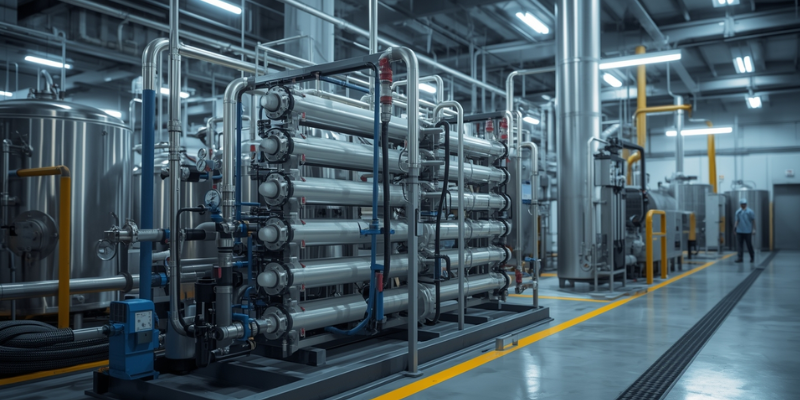
What Is an Industrial Water Filter and How Does It Work?
Water is a resource that is vital in most industries, such as manufacturing, food, pharmaceutical, power plants, and textile industries. Water quality in such industries influences the safety of the product, the life of the equipment and the efficiency directly. It is at this point that the filtration of industrial water becomes highly necessary.
Knowing about Industrial Water Filters
An industrial water filter refers to a system that is meant to eliminate the impurities, suspended particles, chemicals and biological contaminants found in large quantities of water. As compared to domestic water filters, industrial systems are high flow-rate, constructed to fulfill rigid process and regulatory standards.
The water that industries handle is usually sandy, silty, rusty, oily, organic, dissolved salts or even toxic microorganisms. When unchecked, such contaminants may cause damage to the machinery, decrease the heat transfer efficiency, influence the quality of products, and cause higher costs of maintenance. These risks can be checked with the help of industrial filtration, which provides cleaner and more regular water.
The Importance of Industrial Water Filtration
Clean water is not merely safety issue, it is performance as well. Research indicates that the scale that accumulates as a result of hard water can lead to a decrease in the heat exchanger efficiency by up to 40%. On the same note, suspended particles may block pipes, valves, and membranes, resulting in unexpected downtimes.
Industries can, by the appropriate water filter system:
• Keep equipment corrosion and foul free.
• Ensure uniform quality of products.
• Minimize wastage of water by reusing and recycling.
• Meet the environmental and discharge requirements.
The Working of an Industrial Water Filter
The principle of the working depends on the kind of filter, though the majority of systems can be described as a multi-stage operation:
1. Pre-Filtration
This step cleanses big particles like sand, grit and rust. Here screen filters or media filters are usually used to safeguard downstream equipment.
2. Fine Filtration
It is at this stage that smaller suspended solids are eliminated. Finer filtration, sometimes as short as a few microns, is commonly done by cartridge filters or bag filters.
3. Specialized Treatment
Advanced processes such as activated carbon filtration, reverse osmosis or ion exchange can be applied depending on the application. The stages assist in the elimination of dissolved chemicals, odor, heavy metals or excessive salts.
4. After Treatment and Polishing
Final filtration is used to guarantee that the water is to some quality standards, which are needed in industrial applications, e.g. boiler feed water or process water.
Popular Water Filters of industry
• Media Filters - Sand, gravel or anthracite can be used as a layer to entrap the particles.
• Cartridge Filters - Useful in the removal of fine particles.
• Activated Carbon Filters - Eliminate chlorine, organic substances and odor.
• Membrane Systems - Applied to high-purity water.
All the systems are chosen according to the water quality, flow rate, and end-use need, this is the reason why industries usually collaborate with a good Industrial Water Filter Manufacturer.
Conclusion
The industrial water filtration is essential in the reliability of operations, cost reduction, and environmental safety. An intelligent water filter system will not only enhance the quality of the water but it will also have the benefit of a long term sustainability in terms of waste and longevity of equipment.
To obtain a more technical insight as well as tailor-made filtration solutions, companies such as Advance International are operating in the sphere of industrial filtration systems, they are more interested in practical methods of water treatment and filtration issues of modern industries.