 :
:  :
:  :
:  :
: 
Our Blogs
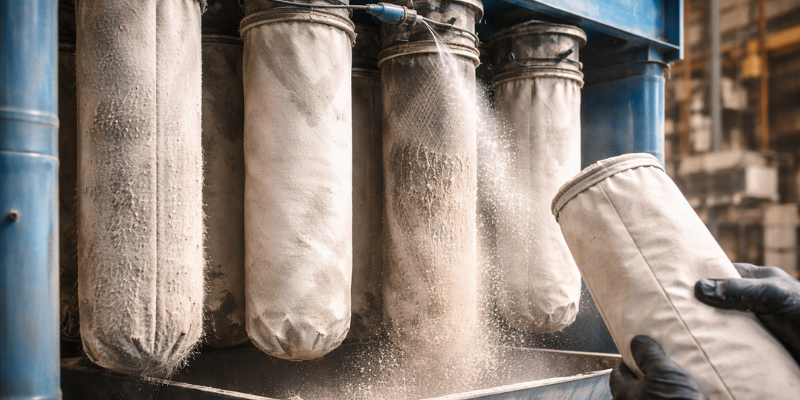
What Is the Functioning of Filter Bags in Baghouse Systems?
The baghouse systems are also common in industries to manage the air pollution and to maintain clean working environments. Filter bags are at the center of such systems and are useful in the extraction of dust and fine particles in the air or gas streams. The mechanism of filter bags can be used to understand why baghouse systems are so useful in industrial air filtration.
What Is a Baghouse System?
A baghouse is a dust collection system that is used to collect the amount of particulate matter in the exhaust air. It is mostly applied in cement plants, steel industries, power plant, and other manufacturing plants that tend to produce a lot of dust. The system draws dusty air inside the fabric filter bags and clean air moves in the system, but dust is trapped on the fabric surface.
Filter Bags Usage in Dust Collection
Filter bags are cylindrical or envelope-shaped pieces of fabric that are fitted to the baghouse. The primary task they do is to remove dust particles in the airflow. The dust particles are trapped on the outer bag of the bags as the air flows past the fabrics. The surface layer of dust accumulates with time and in reality, this increases the rate of filtration by trapping even smaller particles.
Working of Filter Bags
First, contaminated air flows to the baghouse via an inlet. The air flows to filter bags whereby it flows through the fabric material. The cloth is made in such a way that it has small holes that can allow air to pass through but it cannot enter dust particles.
The more dust is deposited on the surface the greater the resistance to airflow. The baghouse has a cleaning mechanism to ensure that the baghouse operates at the required level. Some of the common cleaning techniques are pulse jet cleaning, reverse air cleaning or mechanical shaking. These techniques shake the dust that had been deposited in the filter bags leaving it to fall into a hopper below where it will be safely deposited.
Materials of Filter bags
The filter bags are constructed using various materials depending on temperature, moisture as well as exposure to chemicals. Widely used materials are polyester, polypropylene, aramid and fiberglass. The correct type of fabric used guarantees stability, constant filtration and increased service life. That is why industries tend to use the help of well-known bag filter producers to find the right filter media to the operating conditions.
The effectiveness of Baghouse Filtration
The baghouse systems have potential to obtain over 99 percent of dust collection efficiencies and hence, it is one of the most well-founded solutions to air pollution in industries. They are able to work with big amounts of air and trap very fine particles and in many cases they are below 2.5 microns. Such efficiency assists industries to comply with the environmental standards and safeguard the health of workers.
Significance of Correct Maintenance
Fabric filter bags should be regularly checked and replaced timely to ensure a constant performance. Ripped or deteriorated bags may result in increased emissions, reduction of pressure and even the consumption of energy. Dust collection systems will operate steadily and also the life of the baghouse is prolonged as a result of proper maintenance.
Conclusion
Advance International is also related to the maintenance and support of the baghouse filtration system and is dedicated to the functional knowledge and performance requirements of the filter bag supplies in the harsh industrial settings. For further details, please refer to Advance International